
You have male or female pattern hair loss with stable donor hair on the back or sides of the scalp
You notice thinning at the hairline, temples or crown and want a permanent solution instead of temporary thickening products
You have previous hair transplant work that looks sparse or unnatural and want to improve density or hairline design
You have no untreated medical condition that would significantly increase surgical risk
You understand that full results take months to develop and that transplant cannot restore the hair density you had as a teenager
A consultation with a hair transplant specialist is essential to evaluate your donor area, hair loss progression and realistic options.
Planning and hairline design
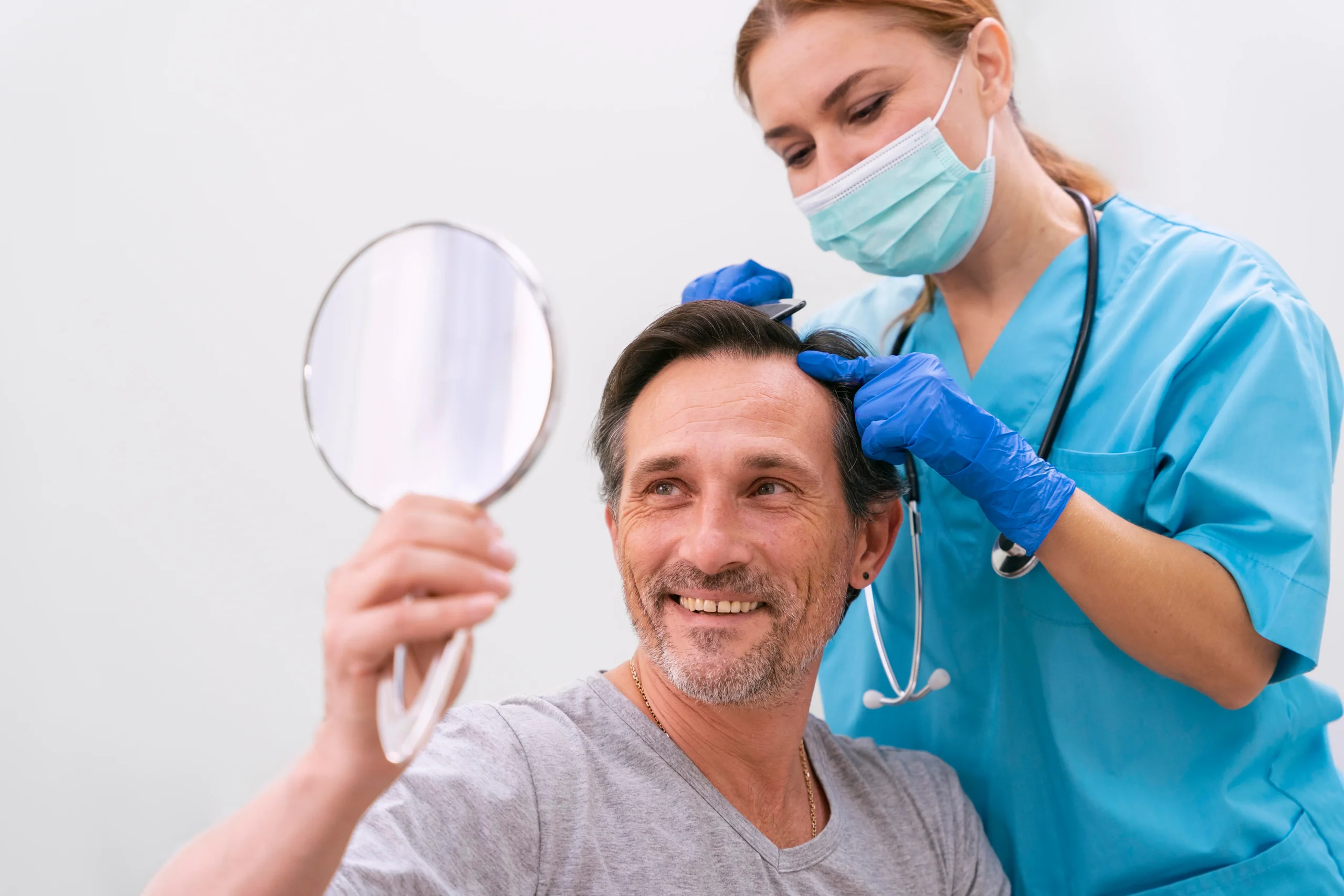
Your doctor examines your scalp, reviews your medical history and designs the new hairline or density area. The plan includes the number of grafts, their distribution and the angle and direction of the transplanted hairs.
Graft extraction from the donor area
Hair follicles are removed one by one from the donor region, usually the back of the head, using a micromotor device. This preserves surrounding tissue and leaves no visible linear scar.
Implantation into thinning or bald areas
The extracted grafts are placed into the recipient area in a pattern that mimics natural hair growth. The direction, depth and density are carefully controlled to achieve a realistic result.
Healing and hair growth
Initial healing takes a few days. Transplanted hairs shed within several weeks, then new growth starts around the third month. Hair continues to thicken over 10 to 12 months, when the final result can be assessed.
We offer two advanced techniques, both based on FUE, and support treatments that protect and enhance your results.
FUE (Follicular Unit Extraction) involves extracting grafts one by one and placing them into tiny channels opened in the recipient area. It is suitable for most patients, allows high graft numbers and leaves only small dot scars that are not visible with short hair.
DHI (Direct Hair Implantation) is a modified FUE method where grafts are implanted directly with special implanter pens. This allows very precise control of angle and density and can be useful for hairline work and partial thinning areas.
For patients who want detailed information about preparation, washing, shedding phase and long term care, and for those considering mesotherapy to support hair quality:
Duration
The procedure usually lasts 6 to 8 hours, depending on the number of grafts.
Anaesthesia and comfort
Local anaesthesia, sometimes with sedation, keeps you comfortable during the procedure. Most patients describe only mild discomfort.
Stay and travel
Many patients travel from abroad. A typical program includes 3 nights of hotel accommodation and follow up visits for washing and check ups.
Recovery
Initial healing takes 2 to 4 days. Small scabs fall off within about 7 to 10 days with proper washing. Most patients return to desk work after a few days.
Activity restrictions
You should avoid heavy exercise, contact sports and direct sun exposure on the scalp for the first weeks. Detailed aftercare instructions are provided.
Results timeline
Temporary shedding of the transplanted hair in the first weeks is normal. New growth usually starts around month 3 and continues to improve up to 12 months and beyond.
Long term result
Transplanted hair behaves like the donor hair. Once fully grown, it can be washed, cut and styled like the rest of your hair.
Experienced doctors directly involved in planning and hairline design
Modern FUE and DHI techniques with focus on graft survival and natural density
Tailored plans for international patients, including transfers and accommodation support
Clear communication about realistic graft numbers, expected coverage and timeline